

GitOps lets you keep the list of sources Context7 indexes in a Git repository, instead of adding them one by one in the dashboard. Alongside Git repositories, a source can be a Confluence space, a website, an llms.txt index, or an OpenAPI specification. Context7 reads a manifest file from that repo and reconciles its own state to match: it indexes anything new, re-indexes anything whose settings changed, and (optionally) removes anything you have deleted from the manifest.
The point is to keep your configuration in code. After a disaster, or when standing up a second environment, you point a fresh instance at the manifest repository and the entire index rebuilds itself with no manual clicks.
Before you start#
GitOps clones your manifest repository and the repositories it indexes using the Git credentials you configure under Settings → Integrations. Connect a GitHub App or a personal access token first; see GitHub Integration. Automatic syncs on every push require the GitHub App (a personal access token cannot receive webhooks).
If you set up the GitHub App before GitOps was available, it is not subscribed to push events and will not trigger syncs. Add the push event to the App on GitHub, or recreate it from Settings → Integrations. See GitHub Integration.
How it works#
You commit a manifest file (by default repos.yaml) to a Git repository. Context7 clones that repository using the same Git credentials you already configured under Settings → Integrations (a GitHub App or a personal access token), reads the manifest, and compares it against the repositories it currently has indexed.
For each source in the manifest, Context7 decides what to do:
- Add it if it is in the manifest but not yet indexed.
- Re-index it if its manifest entry changed, for example a different branch, new folder filters, or a changed page limit, or if its last indexing run did not finish.
- Leave it untouched if it already matches. Running a sync with no changes is a safe no-op.
When pruning is enabled, repositories that you remove from the manifest are also deleted from the instance. Pruning only ever removes repositories that GitOps itself added; repositories you add by hand in the dashboard are never touched.
GitOps is the source of truth only for the repositories listed in the manifest. You can still add other repositories manually in the dashboard, and they will be left alone during a sync.
The manifest file#
The manifest is a YAML file with a list of sources under repos. An optional defaults block applies to every entry unless an entry overrides it.
An entry’s type selects which parser handles it. Omit type and the entry is treated as a Git repository, so manifests written before multi-source support keep working unchanged.
Every entry needs a url (or repoUrl). The remaining fields depend on type:
type | Fields |
|---|---|
git (default) | branch, folders, excludeFolders, excludeFiles, indexSourceCode — the same options as the Add Repository form. |
confluence | Either spaceKey (indexes the whole space; plus spaceId, Cloud only, resolved automatically from the key when omitted, and spaceName) or pageUrls (a list of page URLs to index, which may span spaces) with optional includeSubPages to also index each page’s sub-tree. Plus title and description. Set one form or the other, not both. |
website | maxPages, maxDepth, excludePatterns, title, description. |
llmstxt | maxPages, title, description. The URL must point to an llms.txt, llms-full.txt, or llms-small.txt file. |
openapi | title, description. |
Confluence entries reuse the site URL and API token you set under Settings → Integrations → Confluence, so no credentials go in the manifest. Website, llms.txt, and OpenAPI sources are fetched over public HTTP and need no credentials. Configure Confluence before adding Confluence entries, or the sync reports those entries as failed.
The manifest is validated strictly: an unknown type, a field that does not belong to the entry’s type (a common source of silent mistakes), or a missing required field rejects the whole sync. Nothing changes until the file parses cleanly, so a malformed manifest can never partially apply or wipe your index.
Configuring in the dashboard#
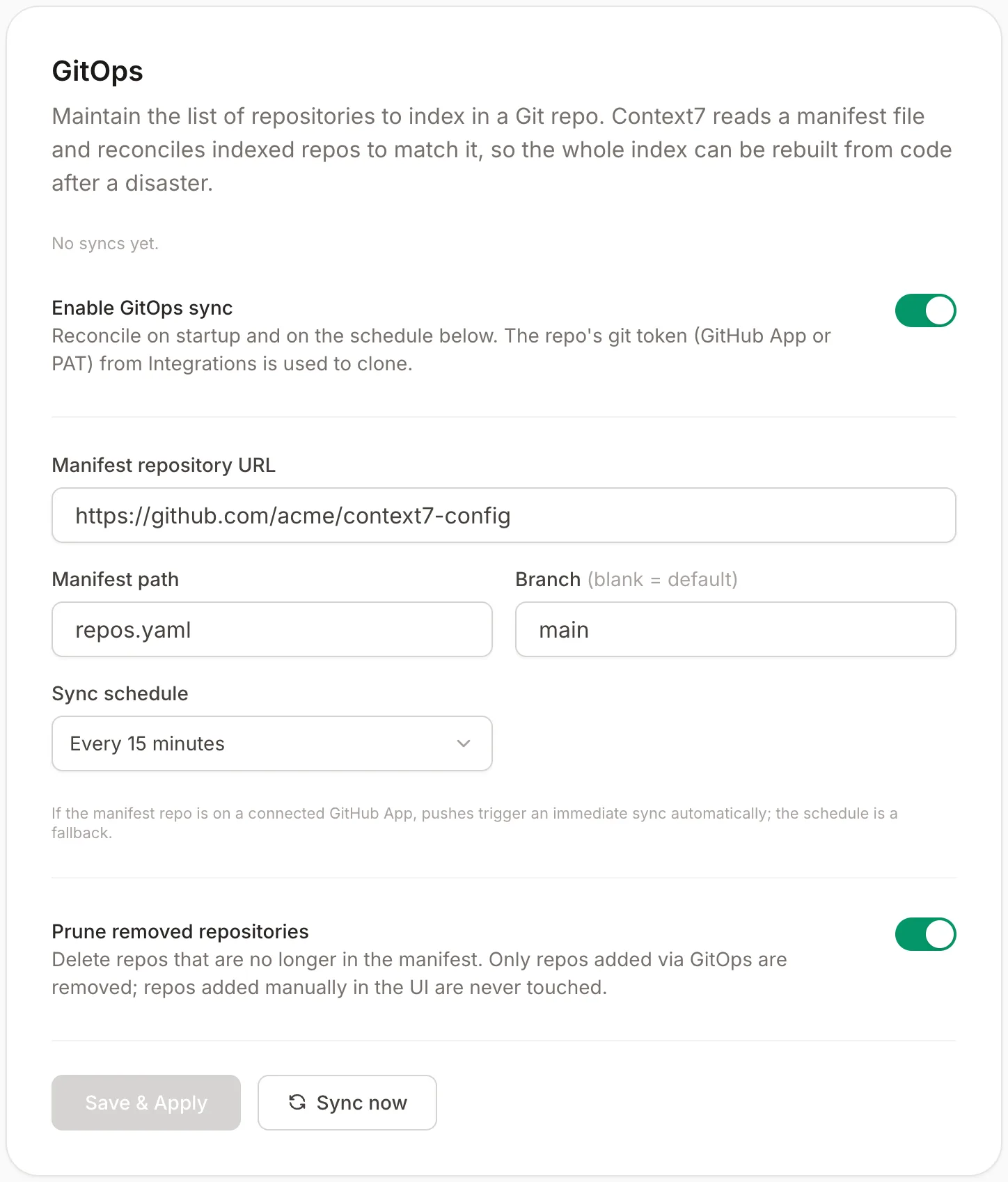
Open Settings → Indexing → GitOps, fill in the manifest repository, and save.
| Setting | Description |
|---|---|
| Enable GitOps sync | Turns on automatic reconciliation (on startup, on the schedule, and on push). When off, nothing syncs automatically, but you can still run a sync by hand. |
| Manifest repository URL | The Git repository that holds the manifest. |
| Manifest path | Path to the manifest within that repository. Defaults to repos.yaml. |
| Branch | Branch to read the manifest from. Leave blank for the default branch. |
| Sync schedule | How often to reconcile automatically. Choose a preset or enter a custom cron expression. Set to Manual only to disable scheduled syncs. |
| Prune removed repositories | Delete GitOps-managed repositories that are no longer in the manifest. Off by default. |
The manifest repository is cloned with the Git token from Settings → Integrations, so private repositories work without any extra credentials. If you have not configured a GitHub App or personal access token for the host, the sync reports a clear error.
Pruning permanently deletes a repository’s indexed data (snippets and embeddings). It only affects repositories GitOps added, never ones you created in the dashboard, but treat the manifest as authoritative once pruning is on. Removing an entry and syncing will delete that library.
When syncs happen#
A reconcile runs in four situations:
- On startup. When the instance boots with GitOps enabled, it reconciles immediately. This is what makes disaster recovery a single step: bring up a fresh instance pointed at the manifest repo and the index rebuilds itself.
- On a schedule. The cron schedule you set acts as a steady fallback that keeps the instance in line with the manifest.
- On push (webhook). If the manifest repository is on a connected GitHub App, every push triggers an immediate sync. See Webhooks below.
- On demand. Click Sync now in the dashboard, or call the API, to reconcile right away.
Repeated syncs are cheap. Context7 remembers the last commit it processed and skips the work entirely when nothing has changed, and it only re-indexes a repository when its manifest entry actually differs.
Webhooks#
When the manifest repository is served by the GitHub App, every push to its configured branch triggers an immediate sync, with no CI step required. Pushes to other repositories or other branches are ignored.
Webhook delivery requires the GitHub App, an instance reachable from GitHub, and the App subscribed to push events. See GitHub Integration for setup, including what to do if you connected the App before push support existed. With a personal access token instead of the App, webhooks are unavailable; use the sync schedule or have CI call the reconcile endpoint.
Disaster recovery#
Because the repository list lives in Git, rebuilding an instance does not require restoring it from a backup. Stand up a fresh Context7 instance, configure your LLM and Git credentials, enable GitOps with the manifest repository URL, and start it. On boot it reads the manifest and re-indexes every listed repository. Your configuration is reproducible from code.
API#
The same operations are available over the REST API and require an admin API key.
To propagate a manifest change from CI immediately (for example when you are not using a GitHub App), call the reconcile endpoint after merging:
The response reports what the sync did, including how many repositories were created, updated, left unchanged, pruned, and skipped.