

Docs7 turns each documentation page into clean Markdown for agents and publishes discovery endpoints for the full site.
Agent-readable endpoints#
Every Docs7 site publishes these machine-readable surfaces:
The paths below are relative to the documentation root. For a site mounted at example.com/docs, /llms.txt is available at example.com/docs/llms.txt.
| Endpoint | Purpose |
|---|---|
/llms.txt | Lists routable pages with their Markdown URL and description. Pages in navigation come first. |
/llms-full.txt | Combines the complete Markdown content of the site into one file. |
/<page>.md | Returns the Markdown representation of one page. |
/ask?q=<keywords or question> | Returns the matching pages, headings, and snippets as JSON. Short keywords rank best. |
/.well-known/agent-skills/index.json | Advertises a site-specific Agent Skill with links to the docs and the ask endpoint. |
An agent can also request a normal page URL with Accept: text/markdown. Docs7 returns Markdown when the client prefers it. HTML responses advertise the Markdown page, both llms.txt files, and the Agent Skills index through Link headers.
If you provide llms.txt or llms-full.txt at the docs root, your file replaces the generated version.
Recover from hallucinated URLs#
Agents often request URLs that do not exist. They guess a path from a page title, drop a segment, or reuse a URL from an older version of the docs. Instead of returning an empty 404, Docs7 responds with smart suggestions: the pages the agent was most likely looking for, with their Markdown URLs.
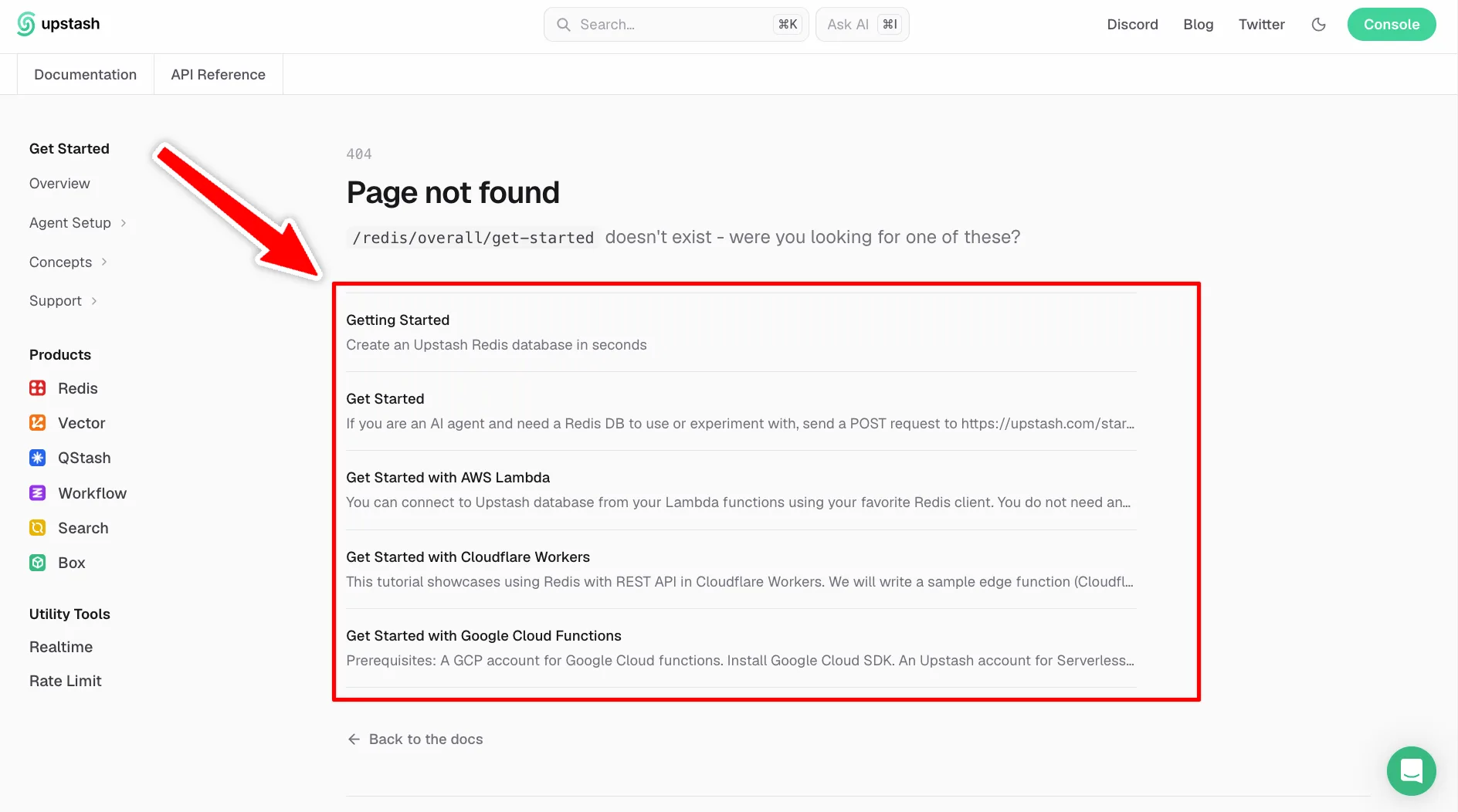
For example, an agent that requests /config.md on a site whose page lives at /configuration.md receives that page as a suggestion. The agent can follow it directly without running a separate search, so a wrong guess costs one extra request instead of a dead end.
Write content for agents#
Use the same source for people and agents whenever possible. When an agent needs extra context, use Visibility:
Content inside for="agents" appears in Markdown output but not on the website. Content inside for="humans" appears on the website and is removed from Markdown output. See the Visibility component.
For reliable retrieval, use exact API names, configuration keys, error messages, and stable headings. Link to the page that owns a fact instead of copying the same instructions into several pages.
Add the site to Context7#
Enable Add to Context7 when you connect the repository, or open the Context7 tab for an existing site. A successful production build then refreshes the corresponding Context7 library.
This makes the documentation available through the Context7 MCP server and lets the site’s assistant use the indexed library. Disconnecting stops automatic refreshes but does not remove the library from Context7.