> ## Documentation Index
> Fetch the complete documentation index at: https://context7.com/docs/llms.txt
> Use this file to discover all available pages before exploring further.
# Add the Chat Widget
> Embed an AI-powered chat assistant on your documentation site
Add an AI chat widget to your documentation site so visitors can ask questions and get instant answers powered by your library's documentation on Context7.
The widget is a lightweight JavaScript snippet that renders a floating chat button. When clicked, it opens a chat panel where users can ask questions about your library and receive AI-generated answers grounded in your documentation.
The chat widget is available to library owners who have [claimed their library](/howto/claiming-libraries).
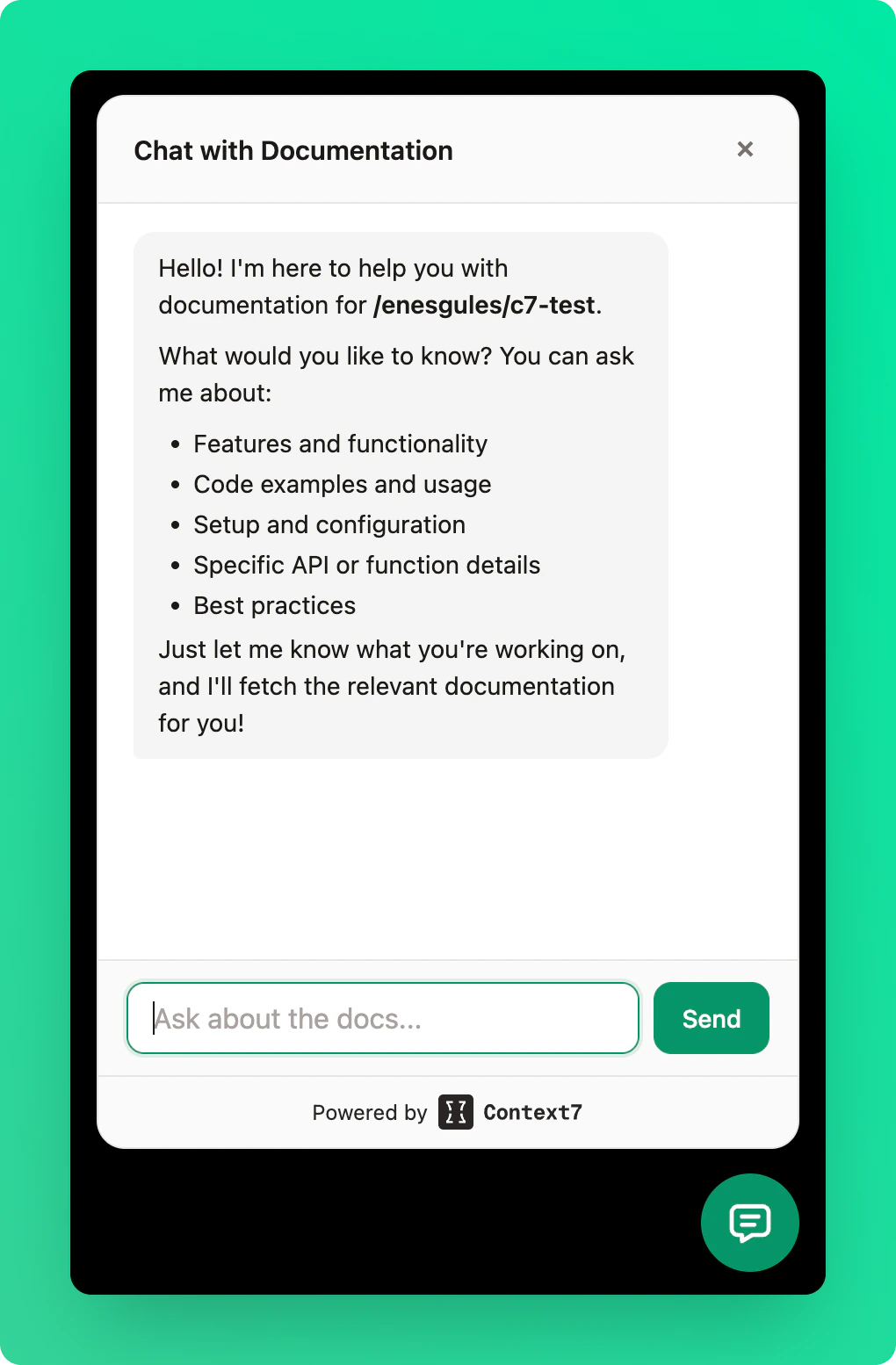 ## How It Works
1. A visitor clicks the chat bubble on your site
2. They type a question about your library
3. The widget searches your library's documentation on Context7
4. An AI model generates an answer using the relevant documentation
5. The response streams back in real time with markdown formatting
## Setup
You must be a verified owner of the library on Context7. If you haven't claimed it yet, follow the [Claim Your Library](/howto/claiming-libraries) guide.
Navigate to your library's admin page:
```
https://context7.com/{owner}/{repo}/admin
```
Open the **Chat** tab and toggle **Widget enabled** on.
Add the domains where the widget will be embedded. The widget will only work on domains you explicitly allow.
Examples:
* `docs.example.com` — exact domain match
* `*.example.com` — matches all subdomains (e.g., `docs.example.com`, `blog.example.com`)
* `example.com` — matches the root domain only
The widget will not work on any external site until you add at least one allowed domain.
Click **Save** to persist your widget configuration.
Copy the embed code from the admin panel and add it to your site's HTML:
```html theme={null}
```
Place this tag in your root layout or HTML file so the widget loads on every page. The script loads asynchronously and does not block page rendering.
## Adding with AI
You can use an AI coding assistant to add the widget automatically. Copy the following prompt and paste it into Claude Code, Cursor, or any AI coding assistant. Replace `/owner/repo` with your library ID. The assistant will detect your framework and place the script tag in the correct location.
```
Add the Context7 chat widget to my documentation site. This is a lightweight
JavaScript widget that adds an AI-powered chat assistant to any webpage. It
loads asynchronously and renders a floating chat button.
The widget is loaded via a script tag:
Detect which framework this project uses and add the widget accordingly. Place
it in the root layout or HTML file so it loads on every page.
Optional attributes: data-color (hex color, default #059669), data-position
(bottom-right or bottom-left), data-placeholder (input placeholder text),
data-welcome-message (initial assistant message shown when the chat opens).
```
## Framework Examples
Use the `next/script` component in your root layout so the widget loads on every page:
```tsx app/layout.tsx theme={null}
import Script from "next/script";
export default function RootLayout({ children }) {
return (
{children}
);
}
```
Add the script to the `scripts` array in your Docusaurus config:
```js docusaurus.config.js theme={null}
export default {
// ...other config
scripts: [
{
src: "https://context7.com/widget.js",
"data-library": "/owner/repo",
async: true,
},
],
};
```
## Customization
The widget supports optional attributes for customization:
| Attribute | Description | Default |
| ---------------------- | --------------------------------------------------- | ------------------------- |
| `data-library` | Your library ID (required) | — |
| `data-color` | Brand color for the widget (hex code) | `#059669` |
| `data-position` | Widget position on the page | `bottom-right` |
| `data-placeholder` | Placeholder text in the input field | `Ask about the docs...` |
| `data-welcome-message` | Initial assistant message shown when the chat opens | Generated from library ID |
### Examples
**Custom color and position:**
```html theme={null}
```
**Custom placeholder text:**
```html theme={null}
```
**Custom welcome message:**
```html theme={null}
```
### Position Options
| Value | Description |
| -------------- | -------------------------------- |
| `bottom-right` | Fixed to the bottom-right corner |
| `bottom-left` | Fixed to the bottom-left corner |
## Domain Configuration
### Allowed Domains
You can configure up to **20 allowed domains** per library. The widget validates the requesting origin against this list on every chat request.
| Pattern | Matches |
| ------------------ | ------------------------------------------------------------------------------- |
| `docs.example.com` | Only `docs.example.com` |
| `*.example.com` | Any subdomain: `docs.example.com`, `blog.example.com`, and `example.com` itself |
| `example.com` | Only the root domain `example.com` |
Domain validation is enforced server-side. Requests from domains not in your allowed list are rejected with a 403 error.
### Adding and Removing Domains
Manage domains from the **Chat** tab on your library's admin page:
1. Click **Add domain** to add a new entry
2. Enter the domain (e.g., `docs.example.com` or `*.example.com`)
3. Click **Save** to apply changes
To remove a domain, click the trash icon next to it and save.
## How It Works
1. A visitor clicks the chat bubble on your site
2. They type a question about your library
3. The widget searches your library's documentation on Context7
4. An AI model generates an answer using the relevant documentation
5. The response streams back in real time with markdown formatting
## Setup
You must be a verified owner of the library on Context7. If you haven't claimed it yet, follow the [Claim Your Library](/howto/claiming-libraries) guide.
Navigate to your library's admin page:
```
https://context7.com/{owner}/{repo}/admin
```
Open the **Chat** tab and toggle **Widget enabled** on.
Add the domains where the widget will be embedded. The widget will only work on domains you explicitly allow.
Examples:
* `docs.example.com` — exact domain match
* `*.example.com` — matches all subdomains (e.g., `docs.example.com`, `blog.example.com`)
* `example.com` — matches the root domain only
The widget will not work on any external site until you add at least one allowed domain.
Click **Save** to persist your widget configuration.
Copy the embed code from the admin panel and add it to your site's HTML:
```html theme={null}
```
Place this tag in your root layout or HTML file so the widget loads on every page. The script loads asynchronously and does not block page rendering.
## Adding with AI
You can use an AI coding assistant to add the widget automatically. Copy the following prompt and paste it into Claude Code, Cursor, or any AI coding assistant. Replace `/owner/repo` with your library ID. The assistant will detect your framework and place the script tag in the correct location.
```
Add the Context7 chat widget to my documentation site. This is a lightweight
JavaScript widget that adds an AI-powered chat assistant to any webpage. It
loads asynchronously and renders a floating chat button.
The widget is loaded via a script tag:
Detect which framework this project uses and add the widget accordingly. Place
it in the root layout or HTML file so it loads on every page.
Optional attributes: data-color (hex color, default #059669), data-position
(bottom-right or bottom-left), data-placeholder (input placeholder text),
data-welcome-message (initial assistant message shown when the chat opens).
```
## Framework Examples
Use the `next/script` component in your root layout so the widget loads on every page:
```tsx app/layout.tsx theme={null}
import Script from "next/script";
export default function RootLayout({ children }) {
return (
{children}
);
}
```
Add the script to the `scripts` array in your Docusaurus config:
```js docusaurus.config.js theme={null}
export default {
// ...other config
scripts: [
{
src: "https://context7.com/widget.js",
"data-library": "/owner/repo",
async: true,
},
],
};
```
## Customization
The widget supports optional attributes for customization:
| Attribute | Description | Default |
| ---------------------- | --------------------------------------------------- | ------------------------- |
| `data-library` | Your library ID (required) | — |
| `data-color` | Brand color for the widget (hex code) | `#059669` |
| `data-position` | Widget position on the page | `bottom-right` |
| `data-placeholder` | Placeholder text in the input field | `Ask about the docs...` |
| `data-welcome-message` | Initial assistant message shown when the chat opens | Generated from library ID |
### Examples
**Custom color and position:**
```html theme={null}
```
**Custom placeholder text:**
```html theme={null}
```
**Custom welcome message:**
```html theme={null}
```
### Position Options
| Value | Description |
| -------------- | -------------------------------- |
| `bottom-right` | Fixed to the bottom-right corner |
| `bottom-left` | Fixed to the bottom-left corner |
## Domain Configuration
### Allowed Domains
You can configure up to **20 allowed domains** per library. The widget validates the requesting origin against this list on every chat request.
| Pattern | Matches |
| ------------------ | ------------------------------------------------------------------------------- |
| `docs.example.com` | Only `docs.example.com` |
| `*.example.com` | Any subdomain: `docs.example.com`, `blog.example.com`, and `example.com` itself |
| `example.com` | Only the root domain `example.com` |
Domain validation is enforced server-side. Requests from domains not in your allowed list are rejected with a 403 error.
### Adding and Removing Domains
Manage domains from the **Chat** tab on your library's admin page:
1. Click **Add domain** to add a new entry
2. Enter the domain (e.g., `docs.example.com` or `*.example.com`)
3. Click **Save** to apply changes
To remove a domain, click the trash icon next to it and save.